
Wingfield American Harrow Buyer's Guide
Originally published April 16, 2020
No two people are alike, and everyone's needs are different. That is why we offer so many different harrow sizes, frames, mounts, and carts in order to satisfy all needs. While it does allow us to claim the world's largest harrow selection, it also can be confusing with the many harrow choices we provide. This guide can help to make sure every customer gets the right harrow for their operation.
### General Rules of Thumb
1. Get the harrow at least a little bit wider than the largest implement you will be pulling it with.
This ensures you will cover your tracks while turning. By adding an extra 6–12" on either side, you get right next to fences and trees without risking tangling your vehicle into them. Anything wider is just sugar on top and gets the job done faster. However, don't discount the time it takes, because our number one complaint from existing customers is "I wish I had bought a larger one." Extra passes cost time and fuel. Plus, the less time it takes, the more often you are willing to do it!
2. You control a harrow on a frame; a drawbar harrow controls you!
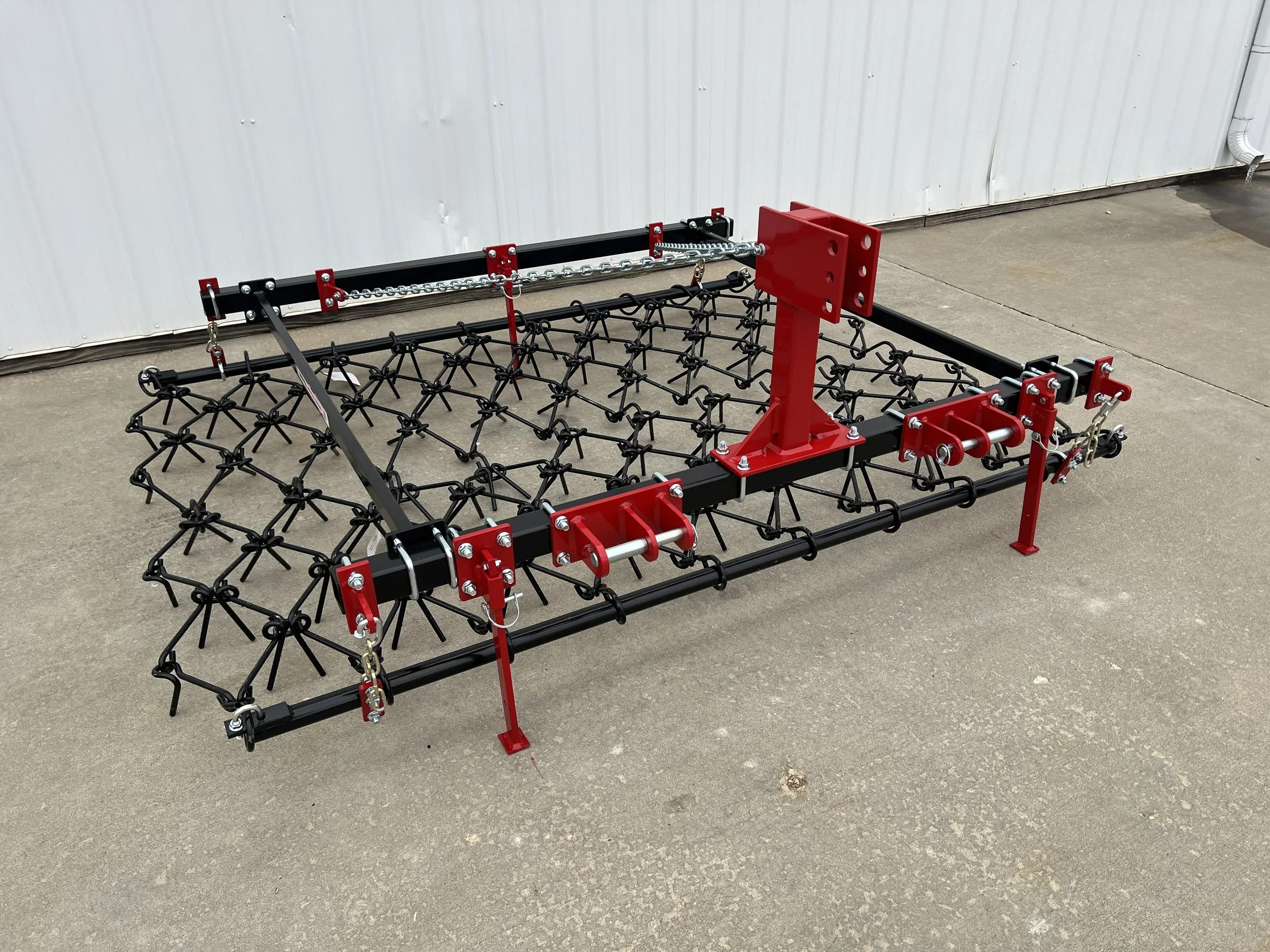
If you have a 3pt. on your tractor, it really is a good idea to get a harrow on a frame, as it will make life much easier on you. With a frame you can back into corners, quickly and easily transport the unit, and you can lift up and shake out any loose material that accumulates. The frame is also fully encompassing, so nothing hangs over the back. A frame mount also keeps the corners from flipping up during high speeds.
Another advantage of the frame is you control how many tines, and the pressure of the tines, that are in contact with the ground. By raising the frame up, you can mimic the ability of pulling it backwards in the less aggressive setting — without having to disassemble or move a drawbar/chain and clevis.
The frame also happens to tie into our second biggest complaint from existing customers: "I wish I would have bought the frame, too." However, this issue is easily solved, as we make a frame for every drawbar (excluding the 4' 0" EconoDrag) we sell. So if you ever need to add the frame at a later date, it is still an option.
### Differences Between Wingfield Harrow Models
Our goal is to have the proper harrow for everyone. That is why we make harrow sections available in widths from 4' 0" – 14' 4" in increments of every 9½". We also have four different lengths of sections (front to back): 2½', 3¾', 5', and 8'. Plus, we don't partake in the "rounding up" of our harrow sizes — a 5' 7" isn't a 6' 0" harrow in our eyes.
Also, the same harrow tine we use on our smallest harrow is the same harrow tine we use on our largest harrow. It is a 4½" long, high-carbon, DRAWN, spring-steel tine that is computer bent to ensure consistent performance and even wear. The tine can be pulled in the aggressive mode (tines standing up), less aggressive mode (tines laying back), or with the harrow mat on its back (tines pointing up in the air). You will not find a higher quality or better performing harrow tine on the market, and it is also 100% made in the USA.
The EconoDrag and Standard Harrow Models
These models were made with the smaller operator in mind (under 20 acres). Both use our smaller 5' long harrow mat, which is ideal for the smaller operator because it can be pulled around and handled by a single person without needing any large machinery. Plus, the mat can be split in half to allow for easy breakdown and transport.
The real question though is: "What is the difference between the EconoDrag and Standard models?" The quick answer: the 3pt EconoDrag frame is set up for a Cat #1 hitch, and the 3pt Standard is set up for a Cat #1 and #2 hitch. All of the tines, drawbar pipes, chains, and clevis are exactly the same (though the EconoDrag has a 6' drawbar chain compared to the 8' chain for the Standard models).
The Maxi, MaxiLift, and 3pt. Pasture Harrow Models
These models were created with the mid-size to larger operator in mind (under 500 acres). All three use our 8' long harrow mat — our longest — which is ideal for the larger operator because the ground can be covered and worked in a single pass.
The Maxi Drawbar Harrow is a two-piece mat (front and rear, with optional single-piece mat available), which allows the unit to be broken down for transport. The 3pt MaxiLift and 3pt Pasture both have a single-piece mat, which maintains more consistent ground contact and eliminates the possibility of unhooking during use.
The Maxi Drawbar Harrow comes in 8', 10', and 12' widths. With an evener bar, two units can be used in tandem to create 16', 20', and 24' widths.
The 3pt. MaxiLift is a fixed-frame harrow, so no expandability. If you don't need a harrow on a frame over 12' 0" wide, this is your model. The frame is lighter than the 3pt. Pasture frame but more than enough to handle harrows between 7' 2" and 12' 0" widths.
The 3pt. Pasture frame comes in 8', 10', and 12' widths. The difference is we beefed up the frame compared to the 3pt MaxiLift to accommodate optional wings. The 4' 9", 5' 7", or 6' 5" hydraulic folding wings can double the size of the entire unit. You can even turn it into a pull-type harrow cart by adding an optional lift cylinder, tongue, and tires. This unit was designed for an operator with growing needs — instead of having to buy a whole new piece of equipment, now you have a piece of equipment that can grow with you!
Mounted Harrow vs. Harrow Cart
When wanting to use a harrow behind an implement, you can either mount it to the rear beam of the unit or have a pull-type cart to trail behind.
The nice thing about mounting a harrow is that you can save a little money and control the length (front to back) of the harrow — 3¾', 5', or 8' lengths. We can mount the harrow behind your existing spike/spring tines, as our mount arms telescope out (a tube inside a tube), so you can move the harrow forward or back and also add on to the harrow mat. Most people opt to go with the flexible tine harrow behind, as it does a superior job compared to a spike/spring tine. We recommend mounting on any unit over 37' wide — we have mounted field cultivators up to 65' in width.
However, we are unable to mount our arms to the back of a V-back unit — we need a straight beam across the back to mount to. Some people get around this by welding a beam across the back. The other potential issue is the added weight on the back of the unit, though most of the time this is not much of an issue.
The great thing about a harrow cart is the ability to use it alone or behind an implement, as well as utilizing the fullest-length harrow mat we make (to get the job done in one pass). To pull behind a unit, all you need to do is weld on a hitch plate and you are off and running. The cart also gives you full control on the number/pressure of the tines on the ground hydraulically, by utilizing the lift cylinder. A cart can be pulled behind a disc, cultivator, ripper, aerator, etc. It can also be pulled by itself to prepare ground for seeding, breaking up manure, shredding frozen corn stalks, and more. By freeing up your 3pt hitch, you can mount a seeder and throw seed into the harrow, saving a pass. These benefits make the harrow cart the most versatile piece of equipment we manufacture.